

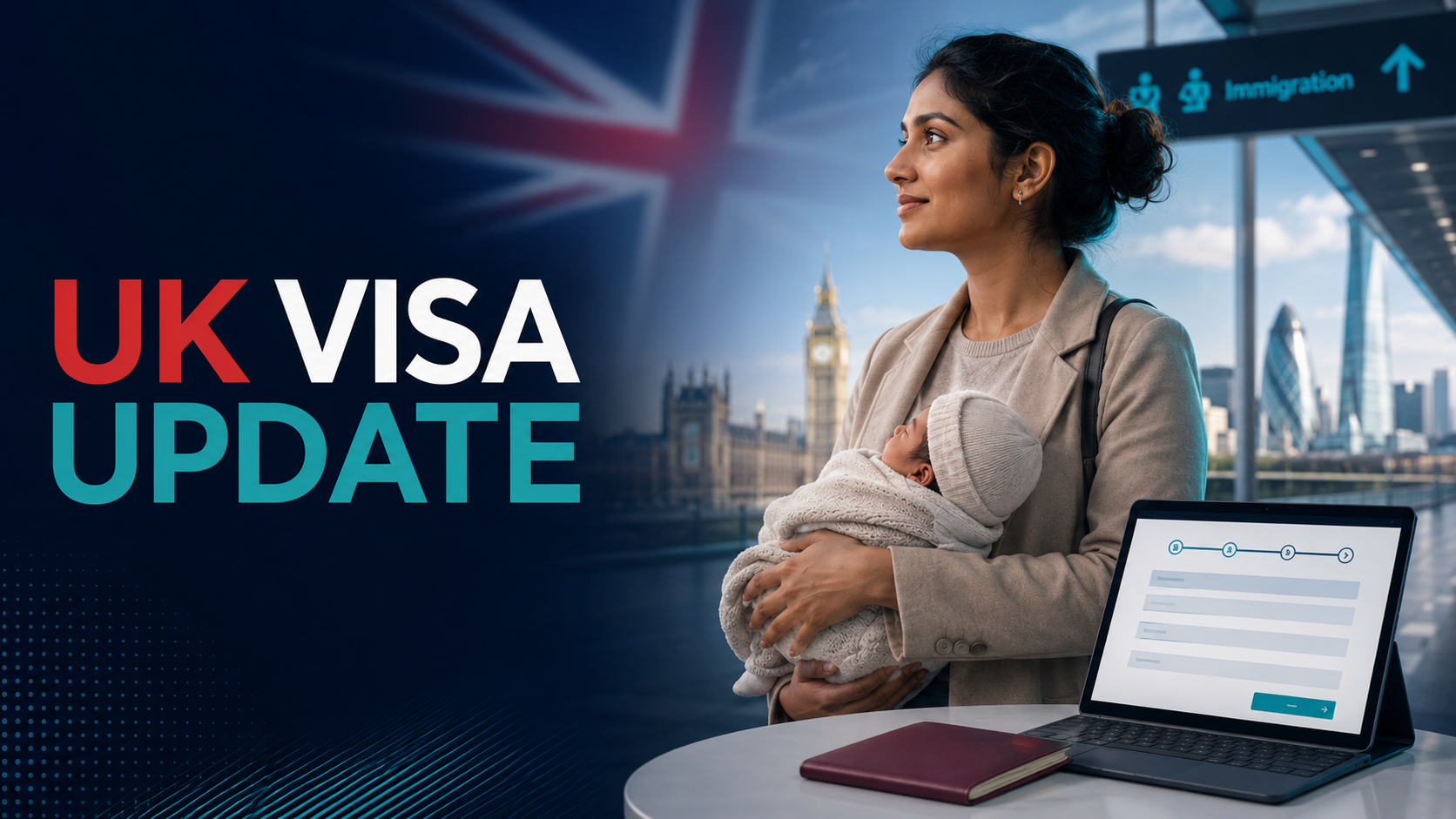
From 3 August 2026, children born in the UK while a parent holds Graduate permission will be able to apply as dependants, correcting an omission that left some international families without a clear route.
By Pentacept Reporters
LONDON: The UK government is changing its immigration rules to allow children born in the country to parents on the Graduate visa route to apply for permission as their dependants.
The amendment, which takes effect on 3 August 2026, addresses a gap that created uncertainty for a small but important group of international families.
Under the previous rules, a child could generally qualify as a dependant on the Graduate route only if the child had already been granted permission as a dependant under the parent’s earlier Student visa.
That arrangement worked for families whose children were born before the parent moved from the Student route to the Graduate route. It did not clearly accommodate a baby born after the parent had already switched to Graduate permission.
The result was an unusual situation. A parent could be lawfully living and working in the UK under the Graduate route, while a baby born during that period had no straightforward route to obtain immigration permission in line with the parent.
The Home Office has now moved to correct that omission.
According to the government’s Statement of Changes to the Immigration Rules, HC 259, a child born in the UK to a Graduate who currently holds permission under the route will be able to apply as that person’s dependant.
The accompanying Home Office explanatory memorandum describes the issue as a gap in the existing rules and says the amendment will give affected children a route to regularise their status in line with their parent.
A correction rather than a new family visa
The announcement has circulated widely among immigration advisers, international student groups and social media communities. Some online posts have described it as a new right for Graduate visa holders to bring additional dependants to Britain.
That description could be misleading.
The change does not create a general opportunity for Graduate visa holders to bring children from overseas. It applies specifically to a child born in the United Kingdom to a parent who holds existing Graduate route permission.
The application must also be made from within the UK, according to guidance published by the UK Council for International Student Affairs.
It is therefore more accurate to view the measure as the correction of a drafting and policy omission rather than a broad expansion of the Graduate visa.
The Home Office has said the amendment will not expand dependant eligibility from overseas and does not create a route to settlement.
For affected parents, however, the distinction does not reduce its significance. A technical omission in immigration law can have serious consequences for a family, particularly when a child needs permission to travel and return to the UK.
Why the child needs immigration permission
Being born in Britain does not automatically make every child a British citizen.
A child’s citizenship normally depends on factors including the parents’ nationality and immigration status at the time of birth. GOV.UK states that a child born in the country to a Graduate visa holder does not automatically become British.
The government’s Graduate visa guidance also explains that parents need to obtain dependant permission for a UK-born child if they want to travel outside the country and return with the child.
This distinction is frequently misunderstood.
A UK birth certificate records the child’s birth but does not, by itself, prove British citizenship or give the child permission to re-enter the country after international travel.
From 3 August, an eligible child will be able to apply for Graduate dependant permission. The parent will normally need to provide the child’s full UK birth certificate showing the names of both parents.
If granted, the child’s permission will be aligned with the Graduate parent’s existing period of leave. It will not extend the parent’s visa or provide the child with an independent entitlement to remain after the parent’s permission expires.
Relief for families, but questions remain
Immigration specialists and student advisers have broadly presented the change as a sensible and overdue correction.
Free Movement, an immigration law publication, described the previous arrangement as an obvious oversight because a baby born after a parent moved to the Graduate route could not possibly have held dependant permission under that parent’s earlier Student visa.
Online discussions among visa holders have similarly focused on the practical relief the amendment may provide. Parents who had delayed travel or were uncertain about their child’s status now have a clearly stated application route.
The change may also reduce inconsistent advice. When immigration rules do not clearly address an ordinary life event such as the birth of a child, families can receive different interpretations from advisers, universities and public information services.
Yet the amendment does not remove every concern.
A dependant application will still carry financial consequences. Visa application fees and the Immigration Health Surcharge can place considerable pressure on a family, especially where the parent’s Graduate permission has only a limited period remaining.
Graduate visa holders must also consider what happens when their own permission ends. The Graduate route is temporary and does not lead directly to settlement. A parent who later moves to another immigration category may need to submit a further application for the child, subject to the requirements of the new route.
Families should therefore avoid treating the August change as permanent protection. It provides immigration permission linked to the Graduate parent, not an independent long-term status.
Part of a wider set of immigration changes
The Graduate dependant amendment is one element of a broader package contained in HC 259, which the Home Office presented to Parliament on 9 July 2026.
Other changes include new provisions relating to children joining settled relatives, permission for partners of people with temporary protection status, Electronic Travel Authorisation criminality rules and travel permits under the EU Settlement Scheme.
Most of the amendments take effect on either 30 July or 3 August 2026.
The new rules also allow certain applications to be considered on their merits where an applicant is on immigration bail but falls within a recognised exception for overstayers. Changes affecting the Electronic Travel Authorisation scheme mean that a suspended sentence of at least 12 months can become a ground for refusing or cancelling an ETA.
These amendments vary considerably in purpose and impact. Some tighten eligibility or safeguarding requirements, while others correct inconsistencies in the existing system.
A small change with a human impact
In numerical terms, the Home Office expects the Graduate route amendment to affect only a small group. Its human impact could nevertheless be considerable.
Immigration policy is often discussed through national statistics, political targets and debates about border control. Behind those arguments are families trying to understand whether a newborn baby can travel, return home or remain lawfully with their parents.
The new provision does not fundamentally transform the Graduate visa. It does something more limited and practical. It acknowledges that children can be born while their parents hold Graduate permission and gives those children a defined place within the rules.
For affected families, that clarity has been missing for too long.
What affected parents should know
From 3 August 2026:
- The child must have been born in the United Kingdom.
- The parent must hold existing Graduate route permission.
- The child’s application must be made from within the UK.
- A full UK birth certificate showing both parents’ names will normally be required.
- The child does not automatically become a British citizen by being born in the UK.
- The child’s permission will be linked to the parent’s remaining Graduate visa period.
- The change does not allow Graduate visa holders generally to bring new dependants from overseas.
- Graduate permission does not provide a direct route to settlement.
Immigration circumstances differ, and families with complex cases should consult current GOV.UK guidance or obtain advice from a properly regulated immigration adviser.
Source note: This report is based primarily on the Home Office Statement of Changes HC 259, its explanatory memorandum, current GOV.UK Graduate visa guidance and analysis published by the UK Council for International Student Affairs. Secondary commentary was used to understand how the announcement is being interpreted publicly, but all statements about the rule itself were checked against official government documents.
