

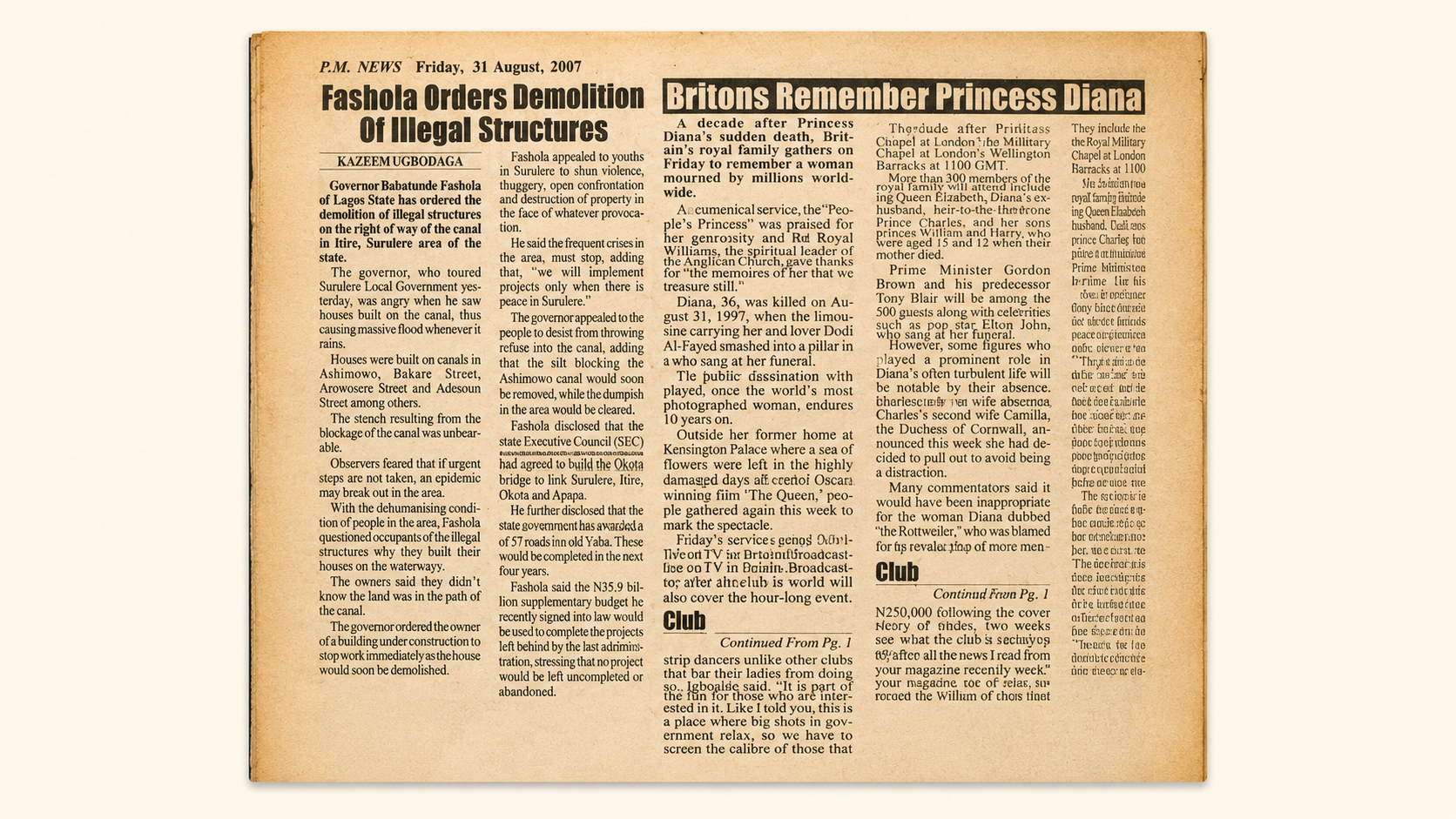
On August 31, 2007, P.M. News reported that then Lagos State Governor Babatunde Fashola ordered the demolition of structures obstructing a canal right of way in Itire and Surulere. Nineteen years later, flooding, blocked drainage channels and development along waterways remain familiar challenges in Lagos.
P.M. News edition of Friday, August 31, 2007, carrying the report, “Fashola Orders Demolition of Illegal Structures.” Archive image: P.M. News.
What Happened on August 31, 2007?
Nineteen years ago today, Lagos was confronting a problem that would remain part of the city’s development conversation for years to come.
On Friday, August 31, 2007, P.M. News reported that then Lagos State Governor Babatunde Fashola had ordered the demolition of structures built on the right of way of a canal in the Itire and Surulere areas of Lagos State.
The directive followed an inspection of parts of Surulere after heavy rainfall.
According to the newspaper report, Fashola expressed concern after seeing buildings constructed around canals, with some structures said to be obstructing the free flow of water.
The report identified locations including Ashowo Bakare Street, Arowosere Street and Adesoun Street.
Fashola reportedly told residents that structures blocking the canal were unacceptable and warned that urgent action was necessary to prevent potentially serious consequences for people living in the area.
A Warning About Lagos’ Drainage System
The issue went beyond the buildings themselves.
According to the 2007 report, Fashola said frequent crises in the area required residents and the government to work together.
He also appealed to residents to stop throwing refuse into canals, warning that silt and waste were reducing their capacity.
The report stated that the governor ordered the owner of a building under construction to stop work immediately because the property would soon be demolished.
For an administration that had taken office only months earlier, the episode provided an early indication of the approach Fashola would later take towards environmental enforcement and infrastructure in Lagos.
That position remained evident during his governorship. In 2011, following severe flooding, Fashola again said the state would identify and remove obstructions from drainage channels and would not tolerate structures built on established drainage and flood channels.
19 Years Later, the Conversation Continues
What makes the August 2007 newspaper clipping particularly interesting today is not simply its age.
It is how familiar the story still sounds.
Nearly two decades later, Lagos continues to contend with flooding, blocked drainage channels and structures built along waterways.
In June 2026, the Lagos State Government ordered the demolition of illegal structures obstructing canals and drainage rights of way in Agungi, Ajiran and Ikota.
The government said blocked drainage outlets and encroachment on waterways were contributing to persistent flooding in affected communities.
Figures reported earlier in 2026 also showed the scale of enforcement. Lagos authorities said 1,544 structures identified as illegally built on drainage channels had been removed between 2025 and April 2026.
And What About Itire and Surulere?
Perhaps the most striking connection with the 2007 story comes from the same part of Lagos.
In July 2026, the National Emergency Management Agency (NEMA) conducted a flood impact assessment in several Surulere communities following heavy rainfall.
Among the areas assessed were Itire, alongside Orile, Coker, Aguda, Ikate and Ijesha.
NEMA reported that homes and businesses had been affected by flooding and said its assessment indicated that intense rainfall, blocked drainage channels and inadequate drainage maintenance were among the contributing factors.
It creates a remarkable historical parallel.
Itire appeared in the P.M. News report about drainage obstruction in August 2007. It appeared again in an official flood assessment in July 2026.
Then and Now
2007: Fashola orders the demolition of structures obstructing a canal right of way in Itire and Surulere.
2026: Lagos continues removing structures from drainage corridors as authorities battle flooding, while communities including Itire continue to experience flood incidents.
The circumstances are not identical, and Lagos has undergone enormous development over the intervening 19 years.
But the comparison raises an important question:
Nineteen years later, how much progress has Lagos made in protecting its drainage infrastructure and preventing development from obstructing waterways?
That is perhaps what makes looking through an old newspaper so fascinating.
Sometimes history shows us how much has changed.
Other times, it reminds us how long some problems have been with us.
From the Archives
The original P.M. News page dated Friday, August 31, 2007, also carried stories about Nigeria’s losses to oil theft, Britain’s remembrance of Princess Diana 10 years after her death and other political and social developments of the period.
Today in History is a Pentacept Reporters series revisiting notable stories from newspaper archives, examining what happened at the time, what followed and why those stories remain relevant today.
Archive source: P.M. News, Friday, August 31, 2007. Historical newspaper image used for archival reporting and commentary.
