

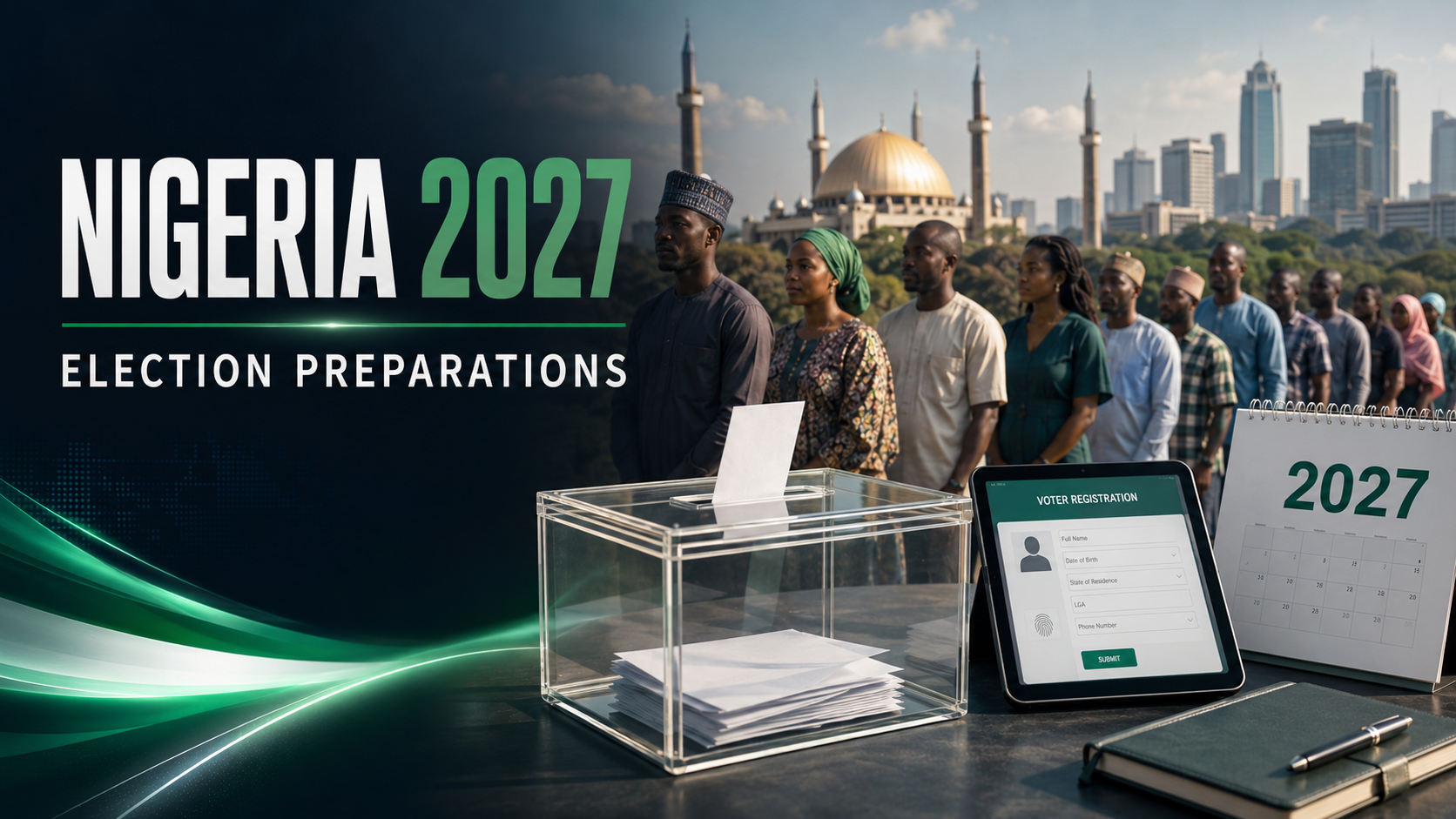
With official campaigns approaching and electoral preparations gathering pace, Nigeria is entering a consequential stage in the journey towards the 2027 general elections.
By Pentacept Reporters
ABUJA, Nigeria: Nigeria is moving closer to the 2027 general elections as the Independent National Electoral Commission, political parties, civil society organisations and prospective voters enter a critical period of preparation.
Formal campaigning has not yet begun, but political activity is becoming more visible. Parties are organising their structures, managing internal disagreements and preparing to present their candidates and programmes to the electorate.
Public debate is also gradually turning towards the choices Nigerians may face in 2027. Questions about the economy, insecurity, employment, public services and the cost of living are likely to become central to the campaigns.
According to the revised timetable published by the Independent National Electoral Commission, campaigns for the presidential and National Assembly elections will begin on 19 August 2026.
Campaigns for the governorship and State Houses of Assembly elections are scheduled to commence on 9 September 2026.
The presidential and National Assembly elections are scheduled for 16 January 2027, while the governorship and State Houses of Assembly elections will follow on 6 February 2027.
These dates place Nigeria at an important point in the electoral calendar. Political parties must prepare to present their programmes to voters, while INEC faces the demanding task of demonstrating that the electoral system is ready for another nationwide test.
Preparation is not the same as campaigning
The distinction between internal political preparation and public campaigning is important.
Political parties may conduct internal meetings, organise their membership, develop policies and prepare for elections. Politicians can also participate in public debate and comment on national issues.
Formal campaigning, however, involves an organised effort to promote or oppose a political party or candidate. It can include rallies, political advertisements, posters, direct appeals for votes and other forms of public mobilisation.
Section 98 of the Electoral Act 2026 states that public campaigning by political parties shall commence 150 days before polling day and end 24 hours before voting begins.
For the presidential and National Assembly elections, the official campaign period therefore begins on 19 August 2026. Governorship and State Houses of Assembly campaigns will begin three weeks later.
The political atmosphere may already be changing, but parties, candidates, supporters and media organisations must still observe the legal timetable.
The boundary can become difficult to define when endorsements, public gatherings and promotional messages appear before the official campaign period. An event described as a party meeting, for example, may carry many of the features of a public campaign rally.
INEC will need to apply the rules consistently. Selective enforcement, or even the perception of it, could weaken public confidence before voting begins.
The administrative work has already begun
Election preparation starts long before campaign speeches, posters and rallies dominate public attention.
INEC’s responsibilities include maintaining the voter register, receiving and publishing candidate information, arranging election materials, deploying technology, recruiting and training temporary personnel, coordinating security arrangements and communicating procedures to voters.
The commission must also work with political parties, media organisations, civil society groups and security agencies across Nigeria’s 36 states and the Federal Capital Territory.
An analysis of the electoral calendar by the Policy and Legal Advocacy Centre notes that the Electoral Act 2026 altered important legal deadlines and produced a compressed timetable for parties, election administrators and other participants.
A shorter timetable does not make a credible election impossible. It does, however, leave less room for delayed decisions, unresolved disputes, logistical failures or poor communication.
INEC will ultimately be judged not only by its plans but by how consistently and transparently those plans are implemented.
Voters will expect accessible registration services, dependable information, properly trained officials, secure polling locations and a transparent system for recording and declaring results. Political parties will expect equal treatment, while election observers will examine whether procedures are applied consistently across states and constituencies.
Election misinformation is already circulating
The spread of false electoral information provides another sign that Nigeria is moving into election season.
A graphic circulated online recently claiming that INEC had issued a separate campaign timetable with different closing dates. The commission rejected the material as false.
Adedayo Oketola, Chief Press Secretary to the INEC chairman, told Punch that the commission had not released a separate campaign timetable. He said the authentic dates were already contained in the revised timetable issued by INEC.
The altered graphic reportedly changed the closing date for presidential and National Assembly campaigns from 14 January to 15 January 2027. It also moved the closing date for governorship and State Houses of Assembly campaigns from 4 February to 5 February.
The differences may appear minor, but inaccurate election information can create confusion. It may also expose political parties, broadcasters and publishers to possible breaches of campaign rules.
The incident is an early warning for voters and news organisations.
As campaigns approach, altered documents, fabricated statements, misleading videos and unverified opinion polls may circulate across digital platforms. Some may be shared by people who believe they are genuine. Others could be produced deliberately to influence voters, damage opponents or weaken confidence in the electoral process.
News organisations have a responsibility to verify electoral claims before publication. A widely shared image is not automatically an official document, and any statement attributed to INEC should be checked against the commission’s website and recognised communication channels.
Political parties must also discourage candidates, supporters and unofficial campaign groups from distributing false information on their behalf.
Parties must offer more than personalities
Campaign season will bring familiar scenes, including rallies, political slogans, music, colourful clothing and large public gatherings.
Such activities are part of democratic participation, but Nigeria’s challenges demand more than political spectacle.
Voters need clear proposals on insecurity, employment, food prices, electricity, education, healthcare, infrastructure and public finances. They also need to know how parties intend to fund their promises.
The campaign period should allow citizens to compare policies, records and leadership capacity. If the election is reduced to personality, ethnicity, religion or regional loyalty, some of the country’s most urgent problems may receive little serious examination.
Political parties should use the remaining preparation period to develop credible and measurable programmes.
Manifestos should be published early enough for journalists, researchers, civil society organisations and voters to examine them properly. Candidates should also participate in debates and detailed interviews where their plans can be tested beyond prepared campaign speeches.
What voters can do now
Election preparation is not solely the responsibility of INEC and political parties.
Voters can use this period to confirm their registration status, follow official announcements and begin examining the records and proposals of prospective candidates.
INEC provides an official Voter Verification Status portal where citizens can check their registration details.
Members of the public should also become more careful about the political information they share. Before forwarding a timetable, candidate list, survey or official-looking statement, users should check whether it appears on INEC’s recognised platforms or has been confirmed by credible news organisations.
The quality of an election depends partly on the quality of the information available to voters.
Nigerians living abroad will also remain active in political discussions through professional associations, community networks, family connections and digital platforms. Their participation can strengthen public debate when it is informed by verified evidence rather than partisan misinformation.
Security remains a central concern
A national election cannot be considered adequately prepared if voters, officials, journalists and observers cannot participate safely.
Election security requires cooperation among INEC, law enforcement agencies, political parties, community leaders and civil society organisations.
Security personnel must protect voters and election officials without intimidating them. Security measures must also be applied impartially, regardless of the party controlling a state or the political identity of a candidate.
Political parties and candidates should commit themselves to peaceful campaigning and discourage supporters from using threatening or inflammatory language. Political disagreement must not become an excuse for intimidation or violence.
A test of institutions as well as candidates
The 2027 general elections will be a contest among political parties and candidates, but they will also test the strength of Nigeria’s democratic institutions.
INEC must demonstrate competence, independence and transparency. Political parties must show that they can compete within the law. Security agencies must protect the process impartially, while the media must report accurately and resist manipulation.
The courts may also be required to resolve pre-election cases involving nominations, party leadership and candidate eligibility. Timely decisions will be important if legal uncertainty is not to follow candidates and voters into the election period.
For citizens, the months ahead provide an opportunity to demand greater substance from those seeking public office.
The central question should not simply be who wants to lead Nigeria. Voters should ask what candidates intend to achieve, whether their plans are realistic, how those plans will be funded and how their performance will be measured.
The countdown has begun
Nigeria is not yet in the formal campaign period, but the country has entered a significant stage of political preparation.
From 19 August 2026, parties contesting the presidential and National Assembly elections will be permitted to take their campaign messages formally to the public. Governorship and State Houses of Assembly campaigns will follow from 9 September.
Before then, INEC must continue preparing the machinery of the elections, political parties must organise themselves within the law and citizens must learn to separate verified information from political noise.
A credible election is not created on polling day. It is shaped by the decisions, safeguards and conduct established during the months leading to the vote.
Nigeria is preparing for 2027. The quality of that preparation will help determine the credibility of the elections that follow.
Key dates for Nigeria’s 2027 elections
- 19 August 2026: Presidential and National Assembly campaigns begin.
- 9 September 2026: Governorship and State Houses of Assembly campaigns begin.
- 14 January 2027: Presidential and National Assembly campaigns close.
- 16 January 2027: Presidential and National Assembly elections.
- 4 February 2027: Governorship and State Houses of Assembly campaigns close.
- 6 February 2027: Governorship and State Houses of Assembly elections.
Editorial note: This analysis is based on INEC’s revised electoral timetable, the Electoral Act 2026, an electoral-calendar analysis by the Policy and Legal Advocacy Centre, and INEC’s clarification concerning a false campaign timetable. Pentacept Reporters does not endorse any political party or candidate.
