

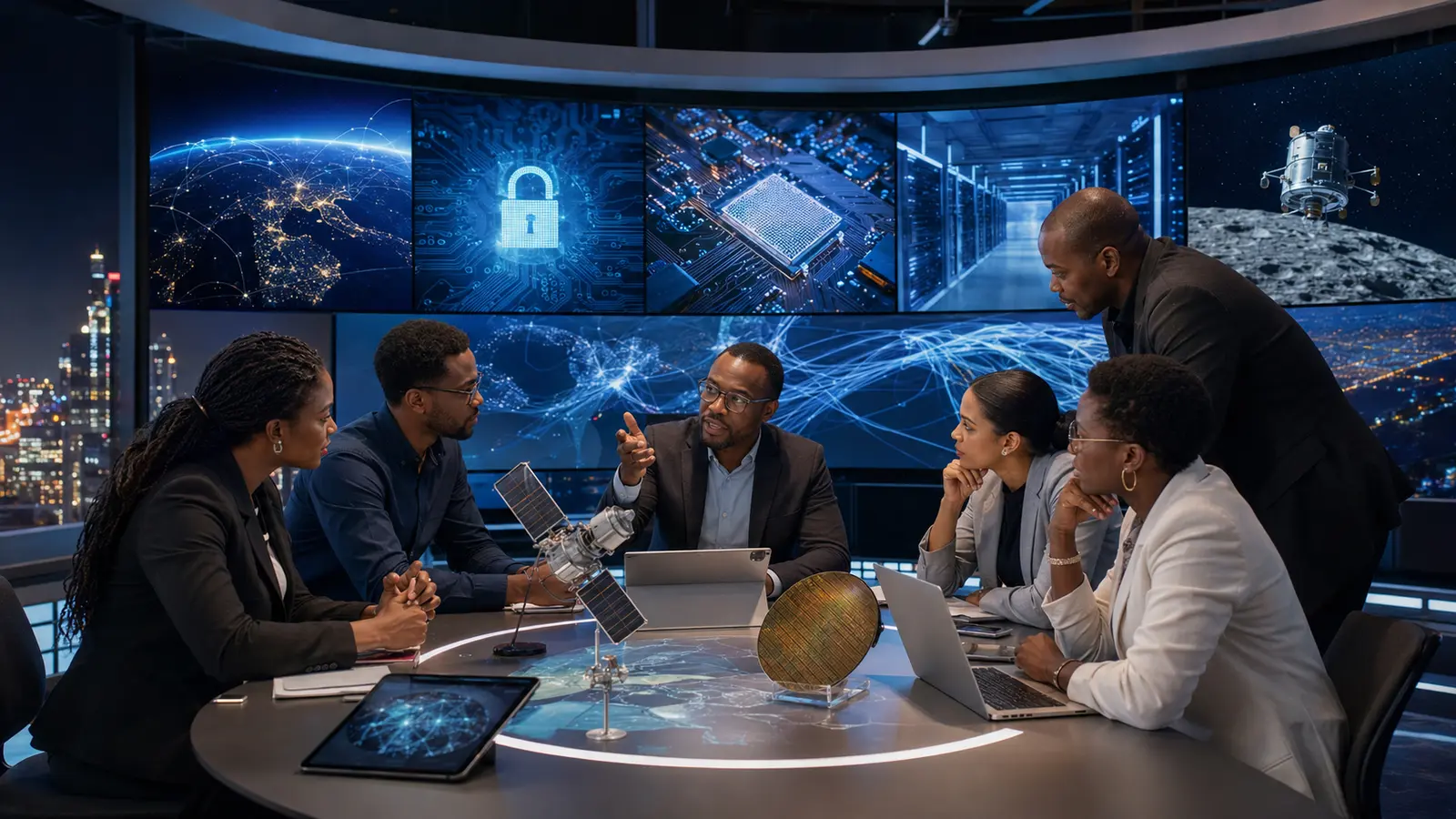
From multibillion-dollar AI infrastructure commitments to new rules for autonomous agents, July’s technology news showed an industry moving beyond model launches and towards the harder questions of power, security, infrastructure and trust.
By Pentacept Reporters Technology Desk
30 July 2026
Technology news in July was not dominated by a single product or breakthrough. Instead, developments across artificial intelligence, cybersecurity, semiconductor manufacturing, digital connectivity and space technology pointed to a broader change in the industry.
AI companies continued their race to secure computing capacity, but the conversation also shifted towards the cost of that expansion. Governments and international organisations paid closer attention to the security risks created by more capable models and autonomous AI agents. At the same time, investment in connectivity and digital infrastructure highlighted how far much of the world still remains from meaningful participation in the technology economy.
Here are some of the developments that shaped the month and why they matter.
Editor’s note: This round-up covers developments announced between 1 and 30 July 2026. The final day of the month is not included.
AI’s infrastructure race entered another phase
For much of the generative AI boom, attention concentrated on the models produced by companies such as OpenAI, Anthropic, Google and Meta. July provided another reminder that the competition now extends well beyond software.
On 22 July, semiconductor company AMD announced a strategic partnership with Anthropic involving the planned deployment of up to two gigawatts of AMD Instinct MI450-series graphics processors. The first gigawatt is expected to begin deployment during the first half of 2027.
AMD also said it had committed to make a future equity investment of up to $5 billion in Anthropic. The two companies plan to collaborate on optimising Anthropic’s Claude models for AMD hardware and improving AMD’s ROCm software platform. AMD
The scale of the announcement is significant. A gigawatt is a measure of power, not computing performance, but its use in AI infrastructure planning illustrates the enormous electricity requirements now associated with advanced model development and deployment.
The wording also requires care. “Up to two gigawatts” describes a maximum planned capacity, not infrastructure already installed. The investment commitment and future deployments remain subject to commercial, technical and regulatory conditions.
A day later, AMD provided an update on its separate relationship with OpenAI. The companies said OpenAI expected to begin bringing AMD’s Helios systems online through deployment partners during the second half of 2026. The installation is intended to form the initial phase of a six-gigawatt GPU arrangement announced in October 2025. AMD
These developments suggest that major AI developers want alternatives to dependence on a single chip supplier. Nvidia remains the dominant provider of advanced AI accelerators, but AMD is attempting to become a more credible second source through hardware, networking and software partnerships.
Competition could eventually reduce costs and increase the availability of computing capacity. However, the industry’s growing demand for electricity, cooling systems, water and data-centre land will face increasing scrutiny.
The next stage of the AI race may be determined as much by energy and infrastructure as by improvements in model intelligence.
Governments began preparing for autonomous AI agents
AI assistants typically wait for a user to ask a question or issue an instruction. Autonomous agents are intended to go further. They can plan tasks, interact with digital services and take actions on a user’s behalf.
This could make AI considerably more useful, but it also creates a difficult problem: how can a bank, employer or government agency confirm that a digital agent is legitimate, authorised and acting within agreed limits?
On 9 July, the International Telecommunication Union announced a new Focus Group on Trust and Identity for Humans and Agentic AI. The initiative will explore standards covering the identity and behaviour of autonomous systems throughout their lifecycle. International Telecommunication Union
The group is expected to consider situations in which an AI agent attempts to conduct a financial transaction, use an online service or interact with critical infrastructure. Its work will involve governments, companies, researchers and civil society organisations.
Standards bodies do not create binding law. Their work can nevertheless influence how technology is designed and whether different products can communicate safely.
The initiative addresses a practical issue that the industry has not yet resolved. Existing identity systems were designed mainly for people, employees, devices and conventional software accounts. An AI agent may act with greater independence, create other agents or operate across several services. Traditional access controls may struggle to determine what it should be permitted to do.
Businesses considering autonomous AI will need more than evidence that the technology can complete a task. They will need controls that establish who authorised it, what information it accessed, which actions it performed and how those actions can be reversed.
July’s announcement showed that AI governance is moving beyond the accuracy of model responses. Identity, accountability and human control are becoming equally important.
Europe presented a new plan for AI and cybersecurity
The European Commission published an Action Plan on Cybersecurity and Artificial Intelligence on 7 July. It outlined three objectives: promoting the responsible use of advanced AI, strengthening European cyber resilience and expanding Europe’s capacity to develop AI-powered security tools.
The plan includes proposals to strengthen the evaluation of advanced models before they enter the European market. The Commission also intends to work with the European Union Agency for Cybersecurity on a secure testing platform for organisations in energy, transport, health, finance and public administration.
An EU Grand Challenge on AI for cybersecurity is also planned to bring together researchers and companies developing security applications. European Commission
The plan complements existing measures, including the AI Act, NIS2 Directive, Cyber Resilience Act, Digital Operational Resilience Act and Cyber Solidarity Act. That broad regulatory structure gives Europe one of the world’s most developed technology governance systems. It can also create complexity for organisations trying to determine which obligations apply to them.
The Commission’s approach recognises that AI has two roles in cybersecurity. Security teams can use it to identify vulnerabilities, analyse suspicious activity and support incident response. Attackers can use similar systems to automate reconnaissance, improve malicious code and identify weaknesses more quickly.
Evidence published by the UK’s AI Security Institute on 17 July added urgency to the debate.
The institute reported that the most capable open-weight AI models it tested were performing at levels comparable to leading closed models released four to seven months earlier. During much of 2025, the measured gap had been between six and ten months. UK AI Security Institute
Open-weight models allow developers to download, examine and adapt their underlying parameters. This supports research, privacy and innovation, but it can also make provider-level safeguards easier to remove.
The findings do not mean that an AI system can independently compromise any well-defended organisation. The institute’s evaluations use defined technical tasks and simulated networks. Real environments include additional controls, active defenders and unpredictable conditions.
The narrowing gap remains important because once a capable model is released openly, access cannot easily be withdrawn. Cyber defenders may have less time to prepare before advanced capabilities become widely available without central monitoring.
The semiconductor battle expanded into optical communication
The computing power required by large AI systems depends on more than processors. Thousands of chips must exchange information rapidly while consuming manageable amounts of electricity.
This has increased interest in silicon photonics, a technology that uses light rather than conventional electrical signals to move data between components.
On 29 July, Reuters reported that the US government had awarded GlobalFoundries $300 million to advance domestic silicon photonics development. The work includes co-packaged optics, where optical communication components are placed closer to computing processors to increase bandwidth and reduce energy use. Reuters
The company is targeting optical modules capable of transferring data at 400 gigabits per second, with a claimed improvement in energy efficiency. As with other company performance targets, those figures will need to be assessed against independently verified production results.
The announcement is part of a wider effort to bring more advanced semiconductor capability into the United States. GlobalFoundries previously received a $1.5 billion CHIPS Act award in 2024 for manufacturing expansion in New York and Vermont.
Silicon photonics may appear less exciting than a new AI chatbot, but it addresses one of the industry’s growing bottlenecks. Faster processors are of limited value if information cannot move between them efficiently.
The technology could eventually support AI data centres, telecommunications, high-performance computing and advanced sensing. July’s funding decision also showed that competition over AI is increasingly becoming a competition over entire supply chains rather than individual chips.
Digital connectivity commitments passed $100 billion
While advanced economies debate the next generation of AI systems, a quarter of the world’s population remains offline, according to the International Telecommunication Union.
On 8 July, the agency announced that its Partner2Connect Digital Coalition had surpassed $100 billion in commitments to expand meaningful connectivity.
The programme, launched in 2021, brings together governments, development banks, businesses and civil society organisations. Its pledges cover broadband infrastructure, digital skills, online safety and technology access. International Telecommunication Union
One of the commitments announced during Geneva Digital Week came from the Asian Development Bank. Its proposed Asia-Pacific Digital Highway aims to mobilise $20 billion in public and private investment by 2035 and improve connectivity for as many as 650 million people.
The $100 billion figure should not be interpreted as money already spent. It represents announced commitments with different delivery periods, conditions and levels of detail. Measuring how much has been disbursed and whether projects improve affordable access will be more important than the size of the headline figure.
Meaningful connectivity involves more than placing a mobile signal within reach. People need reliable electricity, affordable devices, reasonably priced data and the ability to use online services safely. A country can report expanding coverage while a large section of its population remains unable to afford regular access.
This distinction matters for Africa, where mobile connectivity has expanded considerably but cost, device ownership and digital skills continue to limit participation.
AI is likely to increase the economic value of reliable internet access. It may also widen inequality if advanced services are concentrated in areas with strong infrastructure while underserved communities remain disconnected.
Submarine cables received overdue global attention
Cloud computing and wireless networks can create the impression that digital information moves invisibly. In reality, more than 99 per cent of international data traffic is carried through submarine telecommunications cables, according to the ITU.
On 10 July, the International Advisory Body on Submarine Cable Resilience approved its final report. The body was established by the ITU and the International Cable Protection Committee in 2024.
Its recommendations include improving coordination between governments and industry, speeding up repair permits, monitoring risks, diversifying cable routes and strengthening emergency preparedness. International Telecommunication Union
Undersea cables can be damaged by ship anchors, fishing activity, natural hazards and deliberate interference. Repairs may take time because specialised vessels are limited, permits can be complicated and faults may occur far from accessible ports.
Countries dependent on a small number of cable routes face greater exposure. Small island states, developing economies and geographically isolated regions can experience serious disruption when one connection fails.
Nigeria had a visible role in the initiative. Bosun Tijani, Nigeria’s Minister of Communications, Innovation and Digital Economy, served as a co-chair of the advisory body. Abuja also hosted a cable resilience summit in 2025.
The report has no automatic enforcement mechanism. Governments and operators must now decide whether to adopt its recommendations and fund additional routes, maintenance capacity and monitoring.
Its publication was nevertheless timely. As economies move more public services, financial transactions and business operations online, cable resilience is becoming a matter of national security.
NASA moved towards more autonomous activity around the Moon
On 24 July, NASA announced CAPSTONE 02, a planned technology demonstration involving two small spacecraft operating in lunar orbit.
The mission, targeted for launch in 2027, is expected to test autonomous navigation, close-proximity spacecraft operations, communication capabilities and the radiation environment around the Moon. NASA
Its predecessor, CAPSTONE, became the first spacecraft to operate in a near-rectilinear halo orbit, the path intended for NASA’s Gateway lunar station.
CAPSTONE 02 is designed to address a practical requirement for future lunar activity. Spacecraft operating far from Earth will need to navigate and coordinate more independently because relying on continuous ground control is inefficient and can introduce communication delays.
Autonomous rendezvous technology could support the assembly, servicing and resupply of infrastructure around the Moon. It may also contribute to future missions travelling farther into deep space.
The mission is still a proposal under development, and its 2027 launch target could change. Space projects regularly encounter delays involving engineering, testing, funding and launch availability.
Its importance lies less in the size of the spacecraft than in the type of infrastructure NASA is attempting to build. Sustainable activity around the Moon will require communication, navigation and automated operations, not simply rockets capable of reaching it.
Africa’s education technology sector gained a new support programme
On 1 July, the United Nations Development Programme opened applications for a pan-African incubation programme aimed at education technology startups.
The programme is being delivered through UNDP’s timbuktoo EdTech Hub. Eligible companies must be based in Africa, work in education, training or skills development and possess a prototype that can be tested in a local environment.
Selected startups will receive structured incubation, mentoring, investment-readiness support and access to a pan-African network. UNDP said it was particularly interested in businesses led by women, operating in rural areas or incorporating local languages and accessibility features. United Nations Development Programme
The initiative addresses a market with a clear social need. UNDP estimates that more than 100 million young Africans require access to inclusive education adapted to local conditions.
Education technology can improve access, but it should not be treated as a substitute for functional schools, trained teachers and reliable public funding. Digital platforms also face practical limitations involving internet access, device affordability, payment models and the evidence supporting educational outcomes.
The strongest African EdTech businesses may be those designed around local conditions rather than imported assumptions. Offline functionality, low data consumption, local-language content and compatibility with inexpensive devices can be more important than advanced features.
The programme’s success should eventually be judged by how many participating companies build sustainable products, secure institutional adoption and demonstrate measurable learning outcomes.
What July’s technology news tells us
Three themes connected many of the month’s biggest developments.
The first was infrastructure. AI development is becoming increasingly dependent on electricity, data centres, chip supply chains and high-speed communication between processors. These physical requirements will influence where AI systems are built and who can afford to operate them.
The second was trust. Autonomous agents create questions about identity and accountability, while increasingly capable models complicate cybersecurity. Governments are beginning to develop standards and evaluation systems, but technology continues to advance faster than most regulatory processes.
The third was access. More than $100 billion has been pledged towards connectivity, yet billions of people still lack affordable and useful internet access. The economic gap between those able to benefit from AI and those who remain disconnected could become one of the defining inequalities of the next decade.
What to watch in August
Several developments will deserve attention in the coming month:
- How governments and companies respond to the EU’s AI and cybersecurity plan
- Whether major AI infrastructure agreements produce clearer information about energy use and deployment timelines
- Progress towards applying the ITU’s recommendations on submarine cable resilience
- Further evidence on the cybersecurity capabilities of open-weight AI models
- The scheduled launch of NASA’s Nancy Grace Roman Space Telescope, currently targeted for 30 August 2026
- Whether global connectivity commitments move from announcements to funded and measurable projects
July did not produce one invention that changed everything overnight. It showed something more consequential: the technology industry is building systems that require vast amounts of capital, energy, infrastructure and public trust.
The companies may be developing the products, but governments and societies will determine where those systems are permitted to operate, how securely they are deployed and who is able to benefit from them.
This article is an original Pentacept Reporters news analysis based on official announcements, regulatory publications and independently reported information available as of 30 July 2026. Company forecasts and future deployment commitments have been identified as such.
