

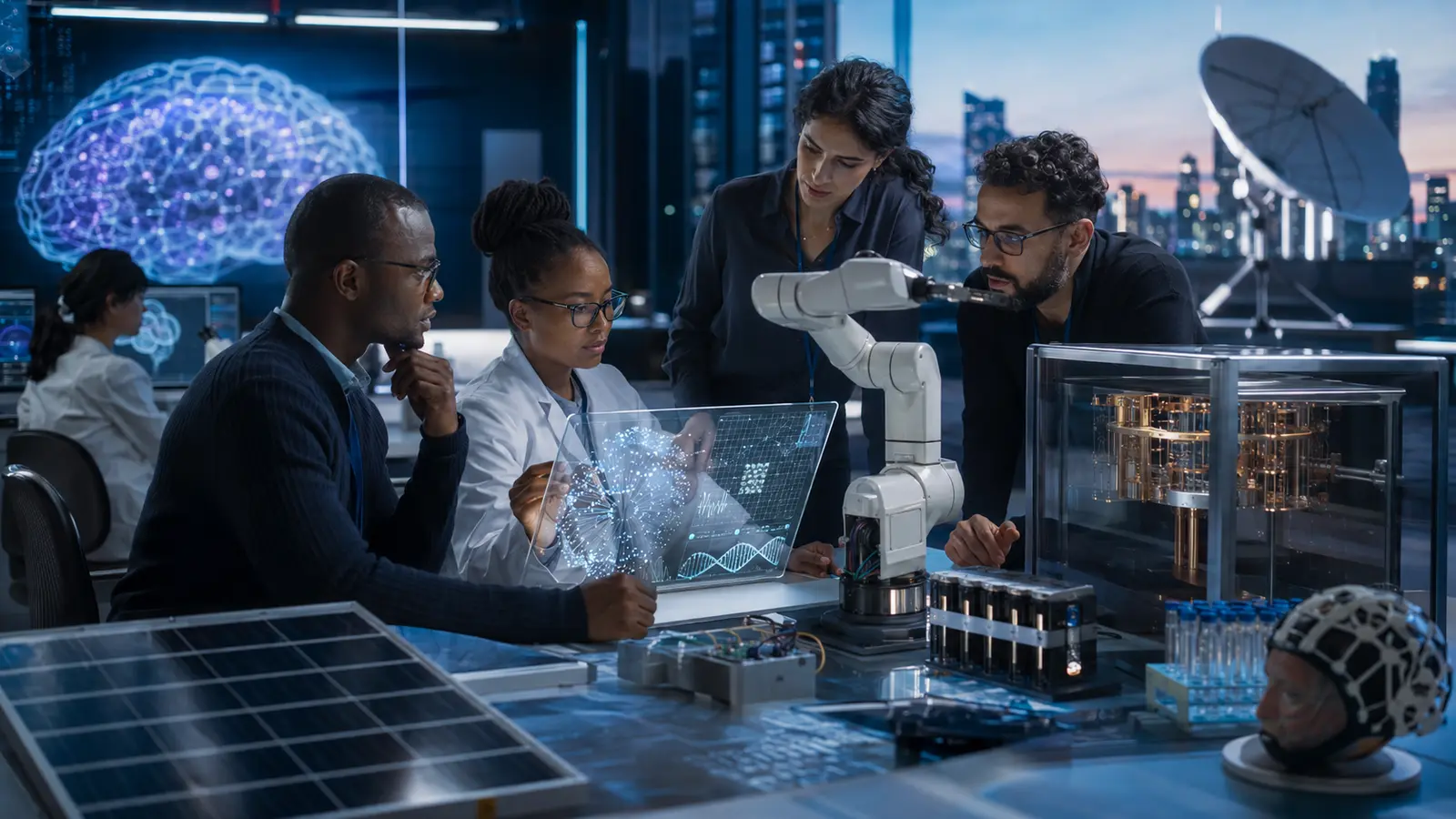
Artificial intelligence dominates today’s technology conversation, but advances in robotics, quantum computing, biotechnology, clean energy and satellite connectivity are also preparing to reshape the world.
By Pentacept Reporters Technology Desk
August 2026
Artificial intelligence has become the biggest technology story of the moment. It can write computer code, generate images and videos, assist scientific research and perform tasks that once required trained professionals.
AI, however, is only one part of a much broader technological shift.
Important developments are taking place inside laboratories, hospitals, factories, energy systems and space programmes. Some are being accelerated by artificial intelligence. Others are intended to address problems that conventional computing, infrastructure or medical treatments cannot solve efficiently.
Together, these technologies may influence how people work, communicate, receive medical treatment, produce energy and protect information during the next ten years.
Technology forecasting requires caution. Promising inventions often take longer to reach the public than their developers predict. Cost, regulation, infrastructure, safety concerns and public acceptance can delay even the most impressive breakthrough.
A credible forecast should therefore look beyond exciting demonstrations. It should ask which technologies have gathered enough scientific evidence, investment and practical momentum to make a meaningful impact by 2035.
Robots are leaving controlled factory environments
Robots have worked in factories for decades, particularly in automotive and electronics manufacturing. Most traditional industrial robots repeat programmed movements inside carefully controlled spaces.
The next generation is becoming more adaptable.
Improved sensors, computer vision and AI systems are helping machines recognise objects, interpret instructions and respond when their surroundings change. This could allow robots to operate in environments that cannot be completely programmed in advance.
The transition is already visible. According to the International Federation of Robotics, approximately 542,000 industrial robots were installed worldwide in 2024. That was more than double the number installed ten years earlier.
The global operational stock reached about 4.66 million units. Asia accounted for 74 per cent of new deployments, compared with 16 per cent in Europe and 9 per cent in the Americas.
These figures do not mean humanoid robots will suddenly appear in every home. Specialised machines are more likely to lead the expansion.
Warehouses will increasingly use autonomous systems to retrieve and move goods. Hospitals may deploy robots for deliveries, disinfection and selected procedures. Agricultural equipment is becoming better at identifying weeds, monitoring crops and applying chemicals more precisely. Assistive machines could also support mobility and routine care in countries with ageing populations.
Humanoid robots are attracting considerable investment because a machine with a human shape could theoretically operate in buildings and workplaces designed for people. A controlled demonstration, however, is very different from safe and dependable daily operation.
Robots are likely to become more familiar in logistics, manufacturing, agriculture, construction and healthcare during the next decade. People will still be needed to supervise them, resolve unexpected problems and make decisions requiring empathy, context or judgement.
Quantum computing must prove its commercial value
Quantum computing has spent years somewhere between genuine scientific progress and inflated expectations.
Conventional computers process information using bits represented as zeros or ones. Quantum computers use quantum bits, commonly known as qubits. Under certain conditions, these systems could perform specialised calculations that are extremely difficult for conventional machines.
Possible applications include modelling molecules, discovering new materials and addressing selected optimisation problems. Quantum computers are not expected to replace personal computers or ordinary data centres. Their potential lies in handling a limited number of unusually complex tasks.
The central technical problem is error. Qubits are highly sensitive to environmental disturbances, making reliable calculations difficult. Researchers are attempting to address this by combining physical qubits to create more stable logical qubits.
A study published in Nature reported below-threshold quantum error correction. The experiment demonstrated that increasing the size of an error-correcting code could reduce the logical error rate under the conditions tested.
It was an important scientific milestone, but it did not establish that commercially useful, general-purpose quantum computing had arrived.
Researchers and technology companies must still demonstrate that quantum systems can produce valuable results more efficiently or accurately than advanced conventional computers. Pharmaceuticals, chemistry, materials research and government-funded scientific programmes are among the areas where this may be tested.
Quantum development is already influencing cybersecurity planning. A sufficiently capable future quantum computer could undermine some of the public-key cryptographic systems used to secure banking, communications and government information.
In August 2024, the US National Institute of Standards and Technology finalised its first three post-quantum cryptography standards. NIST encouraged organisations to begin migrating to quantum-resistant systems rather than waiting for a cryptographically relevant quantum computer to appear.
For many organisations, the first major effect of quantum computing may not be faster calculations. It may be the costly and complicated task of identifying and replacing vulnerable cryptographic systems.
Biotechnology is making medicine more programmable
The approval of the first treatment using CRISPR gene-editing technology marked an important moment in medical history.
In December 2023, the US Food and Drug Administration approved Casgevy for certain patients aged 12 and over with sickle cell disease. The treatment modifies a patient’s blood-producing stem cells before returning them to the body.
Casgevy became the first FDA-approved treatment to use CRISPR/Cas9 genome editing.
In July 2026, the FDA expanded the approval of Casgevy to eligible patients aged two and over with sickle cell disease or transfusion-dependent beta thalassaemia.
These approvals demonstrated that genome editing could move from experimental research into regulated clinical treatment.
During the next decade, biotechnology may become increasingly programmable. Scientists are using genomic information, cellular engineering and computational modelling to develop treatments aimed at the biological causes of particular diseases.
Precision medicine could help doctors match cancer treatments to the molecular characteristics of a patient’s tumour. Gene editing may provide new approaches to inherited disorders. Engineered immune cells could also be used against a wider range of cancers and autoimmune conditions.
Several obstacles remain.
Gene therapies can be extremely expensive and difficult to deliver. Some require chemotherapy, specialist facilities and extensive monitoring. Researchers must also consider unintended genetic changes, immune reactions and long-term safety.
Access is another major concern. Many populations, particularly in low and middle-income countries, remain underrepresented in genomic research. Treatments and diagnostic systems developed from limited datasets may not perform equally well across different populations.
In May 2026, the World Health Assembly endorsed a resolution on precision medicine. It recognised the potential of genomics, advanced diagnostics, data science and digital health while warning that unequal access could widen existing health disparities.
Scientific capability is advancing rapidly. The test for governments and healthcare systems will be whether the benefits can reach more than a small group of patients in wealthy countries.
Brain-computer interfaces may restore lost abilities
Connecting the human brain directly to a computer sounds futuristic, but some of the most persuasive research is focused on a practical medical purpose.
Scientists are developing brain-computer interfaces that could restore communication to people whose ability to speak has been severely affected by paralysis or neurological illness.
These systems record patterns of neural activity and translate them into text, computer commands or synthesised speech.
A 2025 study describing an instantaneous brain-to-voice neuroprosthesis used signals from 256 microelectrodes implanted in the brain of a man with severe speech impairment caused by amyotrophic lateral sclerosis.
The experimental system converted attempted speech into audible words with very low delay. It could also reproduce aspects of expressive speech, including changes in intonation.
The result was significant, but the technology remains experimental. Implanting electrodes requires surgery, the number of research participants remains small and long-term reliability outside specialist facilities still needs to be established.
By 2035, brain-computer interfaces could become more practical for selected patients affected by paralysis, stroke or neurodegenerative conditions. They may help people communicate, operate computers and control assistive equipment.
Claims about consumer brain implants, enhanced memory or routine mind-controlled devices require much greater caution. Medical need may justify the risks associated with brain surgery. Convenience alone is unlikely to provide the same justification.
Neural data will also create difficult privacy questions. Brain signals could become one of the most sensitive forms of personal information. Governments will need rules addressing ownership, storage, consent and possible use by employers, insurers and technology companies.
The most valuable early use of brain-computer interfaces may not be to give people extraordinary abilities. It may be to return independence to those who have lost it.
Clean technology is becoming an economic contest
The transition to cleaner energy is often discussed as an environmental issue. It is also becoming a contest for industrial and economic influence.
Solar panels, batteries, electric vehicles, heat pumps and modern electricity grids are now central to national manufacturing strategies. Governments are competing for access to critical minerals, supply chains, skilled workers and export markets.
According to the International Energy Agency’s Energy Technology Perspectives 2026, the combined global market for major clean-energy technologies reached nearly $1.2 trillion in 2025. The market had grown by an average of 20 per cent annually over the previous decade.
Under the IEA’s current-policy scenario, its value could reach approximately $2 trillion by 2035.
Battery costs have also fallen significantly. The IEA reports that lithium-ion battery prices declined from about $1,400 per kilowatt-hour in 2010 to less than $140 per kilowatt-hour in 2023. More recent analysis found that average battery prices fell by a further 8 per cent in 2025, while the price of battery energy-storage systems fell to approximately one-third of its 2020 level.
Renewable power is also becoming more competitive. According to the International Renewable Energy Agency, 91 per cent of newly commissioned utility-scale renewable capacity in 2024 produced electricity at a lower cost than the cheapest new fossil-fuel alternative.
That comparison relates to new generating projects. It does not mean every existing solar or wind facility is cheaper than every operating coal or gas plant in every market.
The next challenge is managing the variable nature of renewable electricity.
Long-duration storage could preserve power during extended periods of limited sunshine or wind. Smarter grids will be needed to coordinate millions of energy sources and respond to changing demand. New battery designs may also reduce dependence on scarce or geopolitically sensitive materials.
Low-emissions hydrogen could play a role in industries that are difficult to electrify, although production costs, energy losses and infrastructure requirements remain significant limitations.
For developing economies, cheaper solar panels and battery systems could expand electricity access in areas where national grids are unreliable. Countries that import every panel, battery and component, however, may exchange one form of energy dependency for another.
The greater economic opportunity will belong to countries that develop local capacity in installation, engineering, manufacturing, maintenance and recycling.
Satellites are changing how the world connects
Internet access has traditionally depended on infrastructure built on the ground, including fibre-optic cables and mobile-phone towers.
Low-Earth-orbit satellite networks are changing that arrangement. They can provide coverage in regions where constructing conventional infrastructure is difficult or too expensive.
Direct-to-device technology could extend this further by allowing ordinary mobile phones and connected equipment to communicate with satellites without a specialised terminal.
The International Telecommunication Union has described satellite direct-to-device connectivity as one of the most promising developments in broadband technology. It could eventually allow ordinary mobile phones to access space-based 5G services.
The European Space Agency is also working with telecommunications and satellite companies to develop systems that extend mobile coverage directly to standard consumer devices.
The technology could strengthen emergency communications, agriculture, maritime services and environmental monitoring. It may also preserve basic connectivity when natural disasters damage local infrastructure.
Satellite internet will not replace fibre or terrestrial mobile networks. Fibre generally offers greater capacity, while mobile towers remain more efficient in densely populated areas. Satellite services also face concerns involving affordability, spectrum allocation, orbital congestion and space debris.
A signal alone will not close the digital divide. People still need affordable devices, dependable electricity, useful services and the skills to participate online.
Even so, areas once considered too remote for reliable mobile communication may become easier to connect during the next decade.
Cybersecurity is becoming a public-safety issue
As digital technology spreads into hospitals, vehicles, factories, power grids and homes, cyber incidents can create physical consequences.
A compromised email account may expose confidential information. An attack affecting a medical device, industrial control system or connected vehicle could place health and safety at risk.
Artificial intelligence is increasing both the scale of the threat and the capacity to respond.
Criminals can use generative tools to improve phishing messages, imitate voices, create false identities and automate parts of an attack. Security teams are using similar technology to analyse alerts, detect unusual behaviour and respond more quickly.
The World Economic Forum’s Global Cybersecurity Outlook 2026 found that 94 per cent of respondents expected AI to be the most significant driver of cybersecurity change during the year.
The report also identified geopolitical tension, supply-chain complexity and unequal security capabilities as growing concerns.
Digital identity will become increasingly important. Organisations need stronger ways to establish whether a person, document, photograph, voice recording or video is authentic.
Passwords are likely to lose ground to passkeys, hardware-backed authentication and systems that assess risk continuously. Manufacturers will also face pressure to build security into connected products from the beginning rather than treating it as an optional update.
Cybersecurity may gradually become a standard part of engineering, corporate governance, product regulation and national resilience. This reflects its growing importance rather than the disappearance of cybersecurity as a specialist profession.
These technologies will develop together
Robotics, biotechnology, energy, connectivity and computing will not advance independently.
AI will assist researchers analysing genomic information and identifying possible medicines. Quantum computing may eventually support chemical and materials research. Better batteries will power robots, vehicles and remote devices. Satellites will connect machines in locations that conventional networks cannot reach.
This interaction may matter more than any individual invention.
A remotely operated agricultural machine could combine computer vision, autonomous navigation, renewable power, satellite communication and cloud computing. Personalised cancer treatment may depend on gene sequencing, secure medical records, computational analysis and automated manufacturing.
The countries and companies that benefit most may not be those that invent every component. Success could depend on their ability to combine technologies and apply them to important problems.
What the next decade could mean for Africa
The future of technology cannot be judged only by developments in Silicon Valley, Europe and East Asia.
African countries face different challenges, but these can create strong reasons to innovate. Unreliable electricity increases demand for distributed solar power and storage. Limited access to specialist healthcare strengthens the case for remote diagnostics. Large rural populations create opportunities for satellite connectivity and precision agriculture.
The danger is that African countries remain consumers of systems designed, owned and governed elsewhere.
Meaningful participation will require dependable electricity, affordable broadband, effective research institutions and better technical education. Governments also need policies that protect citizens without preventing responsible experimentation.
Control of data will be particularly important. Health, financial and identity information will become increasingly valuable in the technology economy. Countries that fail to govern these resources carefully could provide the data used to build profitable products without receiving a fair share of the benefits.
Africa does not need to adopt every emerging technology. It needs the knowledge and institutional capacity to determine which technologies solve genuine local problems, adapt them to local realities and eventually produce more of them within the continent.
Looking towards 2035
Technical capability alone does not guarantee social progress.
A technology succeeds when it becomes reliable, affordable and useful. It also requires infrastructure, public trust, effective regulation and people with the skills to operate it.
Artificial intelligence will remain influential throughout the next decade, but it will not shape the future alone.
Intelligent machines, programmable biology, quantum systems, cleaner energy and global connectivity are advancing at the same time. Their combined impact could be greater than the effect of any one technology.
The outcome will depend on choices being made now. Governments, businesses and communities must decide whether these advances will serve a narrow group of powerful interests or improve opportunities for a much wider population.
Editorial note: This Pentacept Reporters analysis is based on peer-reviewed research, regulatory records and reports from international institutions available as of 2 August 2026. Forecasts are presented as possibilities rather than established outcomes.
